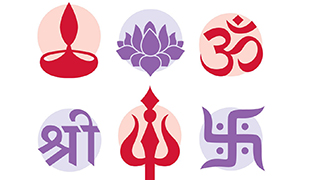
Hindu Symbols
Hindu Symbols
THE SYMBOL OM OR AUM

The Universe began with the sound of 'Aum'. The sound, which is termed Brahmnada, is a symbol of the supreme Brahma. It is considered the most powerful word-symbol used for meditation. The Vedas are the most ancient scriptures of the Hindus and the great Rishis who created them, recognised Om as the symbolic representation of the Ultimate Reality and therefore started all the mantras with the symbol of Om. These great seers who by complete detachment from the world of matter, domination of the senses and inner purification, conquering the self, reached heights of Self-Realisation and gave humanity the Truth, which is Dharma. These great Rishis who performed all actions as acts of sacrifices for the well being of humanity, recognised the significance and power of Om.
In this way, of all the mantras, the Omkar mantra is considered to be the most significant. It is called the pranav mantra. Pranav means something that pervades life or runs through prana or breath. Just as the body depends on prana for survival, the world depends on the sun for its existence. Therefore, It is the practice to worship both these through the power of Om. The symbol stands for the pure consciousness, which pervades the three states of waking, dreaming and deep-sleep. Therefore by recitation of the Omkar mantra, all these states are purified and man's activities at the mental, speech and action levels become powerful and enlightened bringing peace and well being to all.
In all religious activities and ceremonies as also Yajna's performed for humanity's welfare, the recitation of the Omkar mantra will be seen invariably. It is a one-syllable mantra but has tremendous power. By using it in meditation to attain inner harmony and dharma, dhyana and samadhi many aspirants have reached the state of Self Realisatlon. Om brings the light of knowledge on the aspirant's path of realisation.
However, one must earn the right to the use of this holy mantra by being completely unselfish and detached. Those who are selfish and only desire personal fulfillment do not benefit from this mantra. In olden days, only those Rishis who had withdrawn from the outer world of senses and conquered the inner enemies like passion, anger, attachment, greed, jealousy, etc. by proper understanding were allowed the practice of this mantra for humanity's welfare.
Omkar is therefore a symbol of Parabrahim. In it is the complete essence of the divine wisdom - which leads one from attachment to detachment, from ignorance to knowledge, from darkness to light. May it inspire all to the path of Dharma and God-consciousness.
SWASTIK (SATHYO)
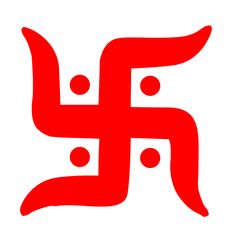
Keeping in mind the welfare of its people, Hindu culture has given a gift of many symbols to its people. With the help of these symbols, an ordinary person can tread the path of liberation. Narshinh, Meera, Valmiki, Kabir, Tulsi, Ramkrishna were all ordinary people but they climbed great heights in life. Not only did they make their lives worthwhile, but also left behind a legacy and inheritance for us. If in life, the deeds done are for human welfare and if the faith is unmoved, then the distance between man and God vanishes.
In the olden days, under the guidance of learned pandits, many rites and rituals were performed. These pundits lived exemplary lives and lived their life for the welfare of others. Such learned priests became the beacons of our lives and thus we were able to have the religious roots for our lives.
During a marriage ceremony, a swastik is painted on the wall or entrance of the house to wish the well-being and happiness of the newly weds. The newborn baby is also blessed by having the swastik painted on his new white gown on the 6th day of his life. During the Chopada Poojan' ceremony, on Diwali day, the swastik is drawn on the new books of accounts so that the New Year proves fruitful. Many women, daily put the sign of the swastik at the threshold of their homes so that happiness peace and love may be established in their household.
The swastik is usually found in the temple, symbolizing the four directions making it universal. It sends out pure vibrations outwards for universal peace and prosperity. The lines turning inwards show that each individual being a part of the Universe has to turn inwards in order to attain salvation. Each person has to strive for his or her self-realisation by turning inwards.
Tilak
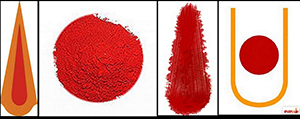
The Tilak, a spot on the forehead, is not merely a beauty enhancing mark, or sign of religiousness. Hindu cultural traditions have given a significant place to Wisdom in life. The life's journey is guided by Wisdom, which will lead us through evolution of life towards salvation. If a man loses everything in his life but has his Wisdom, he can recreate everything he has lost.
In the Vedas, there are mantras which pray: "May my Wisdom be enlightened and purified". The worship that has been revered in the Vedas is symbolised in the Tilak, the forehead mark. The seat of Wisdom is the head and since the forehead is its front part, we worship Wisdom by placing the Tilak on the forehead.
A Tilak is the 'third eye' in a human being. It is not a physical eye but a divine eye which when opened by Divine Knowledge shows the way to self-realisation. When we place a Tilak on our foreheads we are indicating that we wish to acquire this knowledge to pave our way to Moksha.
Lord Shiva destroyed 'Kamadeva' with his third eye. So may we also destroy all our desires and evil elements by striving for knowledge.
The Tilak is also the symbol of good fortune and lasting bonds of wedlock for a married woman. A married woman considers her husband as her deity and merges her life with his. For her sincerity and loyalty to her husband are her life's pledge and thus, just as the river merges in the ocean and loses its identity voluntarily, so does a married woman try to adjust and harmonise herself with the nature, thoughts and wishes of her husband. This reflects her complete faith and trust in the wisdom of her husband.
During many of our religious rites and ceremonies, the priest places a Tilak of sandalwood or red turmeric powder. This signifies the presence of the Almighty during the ceremony. Thus God is the witness during all religious ceremonies and showers benevolence on you so that we may enjoy peace, prosperity and happiness and keep away from violent and chaotic activities.
Menfolk of certain religious sects also place the Tilak on their foreheads, which suggests their acceptance of certain thoughts and ideas as a way of life.
When a person is travelling abroad, the Tilak is placed on his forehead, rice grains are applied on the Tilak, flowers are presented and then Jaggery and yoghurt are given to him as a good omen for his journey. A silent prayer of keeping the mind steadfast while in the foreign land is indicated in this tradition.
A sister placing the Tilak on her brother's forehead signifies her faith and trust in him. Thus the Tilak represents worship of Wisdom and it becomes our duty to maintain its importance in our daily lives.
Hindu Festivals and current calendar
Hindu culture and meaning of religious symbols
Articles about our gods and godesses

Articles submitted by community members
Hindu calendar 2019