Religious articles
Hindu religion articles
The Bhagavad Gita
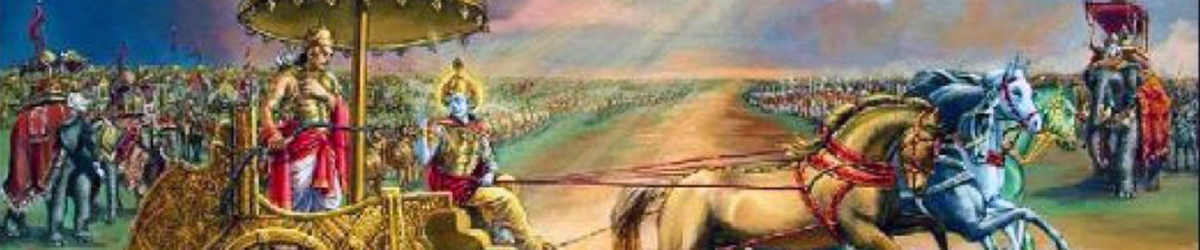
The Bhagavad Gita appears as an episode in the Mahabharata, the epic Sanskrit history of the ancient world. Just before the onset of a war, the supreme lord Sri Krishna delivers this timeless message to his friend and devotee, Arjuna. Their discourse is revered as one of the greatest philosophical and religious dialogues known to man, is today accepted by millions as sacred scripture — a manual foe serving the purpose of human life.
This sacred book no doubt sits proudly in the homes of most Hindu families. However, its use and regular consultation remain limited. Many claim that although it is worshipable it is not easily understandable. Too hard language, too many pages — it’s almost a marathon journey through the text, which many give up after a short stride, leaving the task unfinished. The message however, is simple!
Let us look at in brief, the message of Bhagavad Gita.
Poised in battle formation, the great family conflict between the Kauravas and the opposing side, their cousins, the Pandavas, comes to bear. In the midst of such intrigue, Arjuna abandons the will to fight due to the feelings of compassion for both sides of the family. He fears the war will bring great ruination to family tradition. Should he fight and be a cause of destruction or should he flee and be rebuked a coward? Reluctant to lift his bow in battle, he submits himself for instruction before the Lord. Lord Krishna, the perfect guru, inspired by the Arjuna’s humility and honesty, offers progressive advice to remove Arjuna's doubt. His instructions not only benefited Arjuna, but also are expression of the Lords love for all living beings on this material world. His message in the Bhagavad Gita is a lesson on the ultimate duty of humanity, taught through the following themes;
Jiva- the soul
Arjuna's doubts raise the issue of identity. Who are we?
For whom was Arjuna expressing his compassion? Lord Krishna establishes that there is a clear distinction between the body and person. We may have relationships pertaining this body — mother, father son, daughter etc., however at the time of death the body (and with it the exchanges between the relationships) perishes but the person continues to live. In other words, we are not this body — black, white, man, women, Indian, English — but are the eternal spirit souls jivas. Although Arjuna did not want to kill his grandfather due to love for him, Sri Krishna told him that the body has to come to an end — whether now or later. Just as a person gives up old and useless garments and accepts new ones, similarly the soul discards an old and useless body for a new one. Therefore, there was no need to lament — the soul is eternal indestructible, imperishable, and unborn. But who is the soul? Lord Krishna reveals it's my part and parcel my servant' (Bhagavad-Gita 15.7).
Prakruti- material nature, the world we live in
This nature is described as god's energy thus controlled by Him. It is constituted of gross (earth water air and ether) and subtle (mind, intelligence and false ego) elements that we see feel taste, touch and hear. In this world it is a combination of these elements. Lord Krishna describes that material nature has three specific characteristics, or modes (gunas) - goodness (Sattva), passion (rajas) and ignorance (tamas). These modes are like forces acting upon this world, influencing everything from the different types of food to the behaviour of the living beings. Within this world, the Lord has provided essential ingredients for all living things to sustain their lives. However, He emphatically claims that this world although real, is temporary. It is manifest for a few moments and then vanquished — yet the cycle continues. The Gita reveals that the influence of the material energy upon the living being brings forgetfulness of the Lord. Covered by desires for enjoyment, the living being IS under the illusion to think that he is the body and therefore conditioned to act only for pleasures of the body. This world is incompatible for the soul's desire of ever-lasting happiness, and the Gita offers a process for becoming free from this illusion and hints of a nature beyond this material realm where the soul lives eternally.
Kala — time as the energy of God, time is the dictating and controlling ingredient of this world. It influences everything we do. Sri Krishna says, Time I am, destroyer of the worlds' (Bhagavad-Gita 1 1 .32) life in this material nature is a race against time. In the conditioned state of Iiving, the soul tries to fulfil its ambitions, forgetting that cruel death can call at any moment. The greatest gift acquired with this human duration, and therefore how this time should be utilised in the pursuit of life's mission is taught in the Gita.
Karma — action according to ones desires, a certain pattern of behaviour is moulded in a person. However, whatever action a person performs, material nature rewards in two ways — pleasure or pain. What we think of and therefore, what we do, influences our consciousness, which determines the future destination of the soul. If, simply engrossed in material pursuits, the soul continues on the merry-go-round of birth and death. However the Gita, al living beings can revive their original spiritual consciousness and thus become free from the reactions of past activities. Of the five themes discussed in the Gita karma (action) is within the person's control. In order to improve and change one's activity, one requires knowledge. This is found in the words of Lord Krishna. He offers the secret of a happy and peaceful life. The Gita does not minimise the duties of being a father, mother, son or husband (or even occupational duties) but is suggesting that human life is meant for reviving the spiritual duty and enacting it within our life. Understanding ourselves to be servants of the Lord, the best course of action is 'whatever you do, do it as an offering unto me' (Bhagavad-Gita 9.27)
Isvara — God Sri Krishna, the Supreme Personality of Godhead, as declared in the Gita, is different from the ordinary souls of this world. He is the source of all creation, all destruction — everything rests upon him as pearls are strung on a thread ' (Bhagavad-Gita 7.7). As already mentioned, the soul has a unique relationship with God, and the Gita's mission is not only to reveal this truth but guide one in how this relationship can be cultivated in daily life. Changing one's activities means changing one's consciousness and the Gita is a treatise for those desirous of regaining their original God consciousness or Krishna consciousness.
The Bhagavad Gita therefore tells us
Verse by verse, page by page, Sri Krishna removes Arjuna's perplexity and instils a renewed spirit of duty in battle. The Gita is the secret behind not only a successful material life, but also the process of attaining ultimate spiritual perfection although Arguna appears to be the only recipient of the Lord's holy words, they forever remain available and applicable in our daily life.
The Essence of the Bhagavad Gita
The Bhagavad Gita is the essence of Vedic knowledge and has been crystallized into 700 concise Shlokas (verses) in Sanskrit, which provide a definitive guide to the science of self-realisation. In one short verse, Shri Krishna states all that one needs to know and to do:
To action alone you have the right,
never to the fruit thereof
Let not the fruit of action be your motive;
Nor should you desire to avoid action.
(CHAPTER Il, VERSE 47)
The Gita is universally renowned as the jewel of ancient India's spiritual wisdom, representing the history of India and the Battle of Mahabharata 5200 years ago. The knowledge of the Gita was imparted by Shri Krishna to Arjuna on the battlefield of Mahabharata, as contained in the Vedas and the Upanishads.
The Bhagavad Gita is today taught and read all over the world with veneration and ranks among the foremost scriptures of mankind. It represents one of the finest collections of spiritual thought and has caught the imagination of many scholars. To all those who are unhappy and unsure as to what is true and right, the Gita provides both light and refuge.
The word *Gita' means the celestial song. The knowledge is presented in the form of questions and answers. This style of writing, in the form of a dialogue between a teacher and a student, is a typical style of the Upanishads.
For a Hindu (of any sect) the Gita is as important as the Bible is to Christians. The Gita is used in law courts in Britain and India for oath taking and every Hindu home and temple, both in India and abroad, is guided by this holy book.
The Gita's main task is to remove the illusion of material entanglement and the sense of personal attachment. It reveals the supreme truth and provides rational solutions to the problems and mysteries of life and death, the duties and obligations of human beings. It reiterates the indestructible nature of the soul which is described in detail in the Upanishads. The secret of the teachings of the Gita is selfless activity: the performance of actions and deeds without attachment to the reward. The Gita has attracted the attention of scholars outside India and it has been translated into all the major languages of the world. In Europe the first translation of the Bhagavad Gita from Sanskrit into English was by Sir Charles Wilkins (1750-1836) of the East India Company in the year 1785. This translation influenced the Western mind and accelerated the study of Vedic literature and the Sanskrit language.
Summary of the Bhagavad Gita
- 1. Don't be afraid. Stop worrying uselessly. No one can kill you. The soul within you is immortal. The soul is never born nor does it ever die.
- 2. The past is in the past and the future will depend on the actions performed now and today. Don't repent the past and don't worry about the future, make the present full of worthiness.
- 3. Empty-handed you came into this world and empty-handed you will go. Shri Krishna has created you to be trustee of his gifts. Remember you are only a trustee not an owner. The material things will not remain with you. What is yours today will belong to someone else tomorrow. The happiness you get from owning these is only temporary and this greed will eventually become the cause of your sorrows.
- 4. Change is the law of nature. Death is just another name for life.
One can be rich for a moment and become poor the next moment. Remove selfishness and vanity from your mind and then al will be yours.
- 5. Neither do you belong to the body nor does the body belong to you. It is made up of five elements: fire, water, earth, air and space. It will finally merge back into them. Only the soul is indestructible.
- 6. Your refuge lies in offering yourself to Shri Krishna. This is the best choice. Those who trust in Shri Krishna have no fear, no worry and no grief.
- 7. Your salvation lies in offering all your actions to Shri Krishna. While doing so you will realize a sense of supreme bliss
Shree Krishna Maha Mantra
Jai Shree Krishna Chaitanya
Prabhu Nityananda
Shree Advaita Gadadar
Shivashadi Gaura Bhakta Vrinda
Man-mana bhava mad-bhakto
Mad-yaji mam namaskuru
Mam evaisyasi satyam te
Pratijane priyo 'si me
Always think of Me, become My devotee, worship Me and offer your homage unto me. Thus you will come to Me without fail. I promise you this because you are My very dear friend.
Sarva-dharman parityaya
Marn ekam saranam vraja
Aham tvam sarva-papebhyo
Moksayisyami ma suchah
Abandon all varieties of religion and just surrender unto Me. I shall deliver you from all sinful reactions. Do not fear.
Aharn sarvasya
prabhavo
mattah sarvam
pravartate
iti matva bhajante
mam budha bhava-samanvitah
I am the source of all spiritual and material worlds. Everything emanates from Me. The wise who perfectly know this engage in My devotional service and worship Me with all their hearts.
Harer nama harer nama harer namaiva kevalam
Kalau nasty eva nasty eva nasty eva gatir anyatha
In this age of quarrel and hypocrisy, the only means of deliverance is the chanting of the holy name of the Lord. There is no other way. There is no other way. There is no other way.
HARE KRISHNA, HARE KRISNA,
KRISHNA KRISHNA. HARE HARE,
HARE RAMA, HARE RAMA,
RAMA RAMA, HARE HARE.
The transcendental vibration established by the chanting of the Hare Krishna maha-mantra is the sublime method of reviving our Krishna consciousness. No other means of spiritual realisation is as effective in this age of Kala Yuga as the chanting of the Hare Krishna maha-mantra.
Extracts taken from the Bhagavad Gita As It Is, written and narrated by His Divine Grace A.C. Bhaktivendanta Swami Prabhupada.
Gayatri Mantra
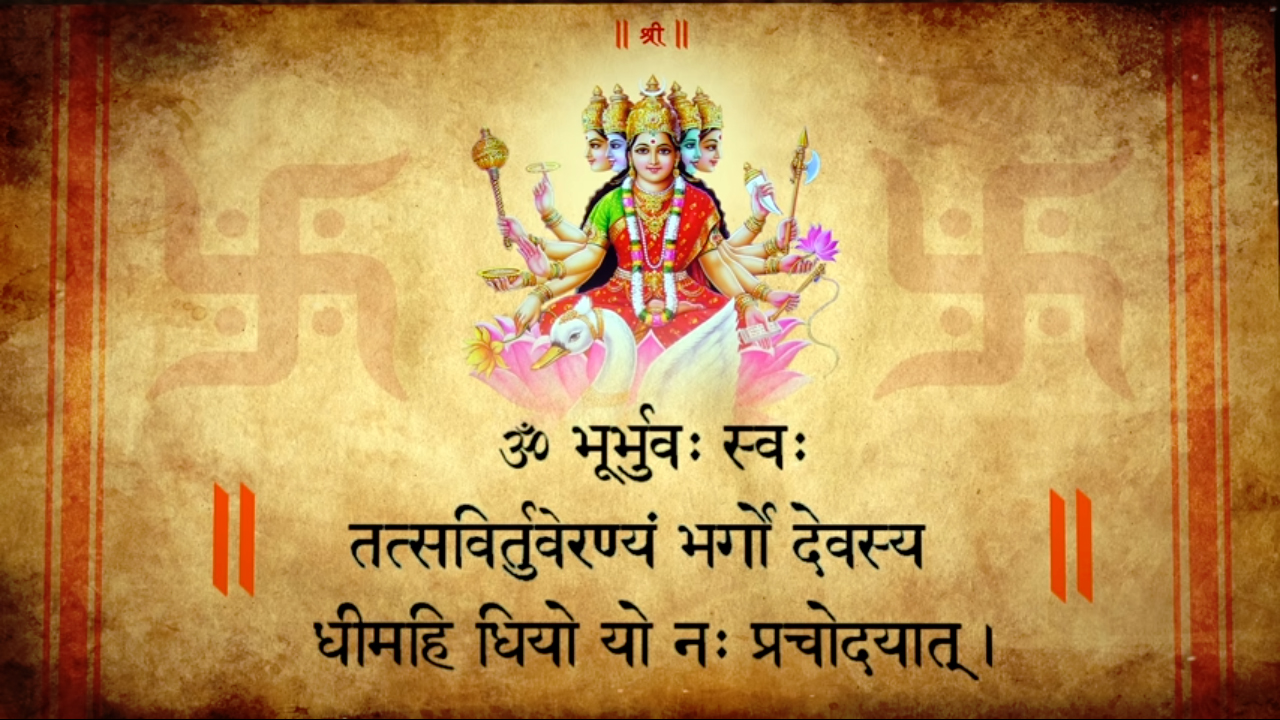
ॐ भूर् भुवः सुवः । तत्स॑वि॒तुर्वरेण्यं॒ भर्गो॑ दे॒वस्य॑धीमहि । धियो॒ यो नः॑ प्रचो॒दया॑त् ॥
0m bhur bhuvah svahah
Tat savitur varenyam
Bhargo devasya dheemahi
Dheeyo yonah prachodayaat
The gayatri mantra is the essence of the three Vedas. It is the Vedas simplied. The more one contemplates and meditates upon the gayatri, the more complexities are revealed to one.
AUM - Supreme Lord
BHUR - Protector of the Earth, the material sheath, the Life breath of the Universe. From the feet to the navel centre
BHUVAH - One of the meanings is the sky. The Lord who pervades and eliminates all miseries. From the navel to the throat centre.
SVAHAH - One of the meanings is the heavens. HIS is all Bliss and blesses His devotees with happiness. From above the throat centre to the thousand petaled lotus.
TAT - That Thou Art
SAVITUR - The Sun, Creator, Preserver and Self Luminous, the central mantra of the Solar Science
VARENYAM - Most fit to be worshipped. Most choice worthy
BHARGO - The burning splendour of the Sun that dispels ignorance, and therefore sorrows and miseries.
DEVASYA - The 'Deva', the God, He who is All Bliss, The Joyful One, The Shining One, The Revealer of All Glory
DHEEMAHI - We meditate upon Him
DHEEYO YONAH - Who our intelligence and Wisdom
PRACHODAYAAT - Inspires.
The Gayatri Mantra was traditionally given from the Guru (Master) to the disciple, while standing mid-stream. Look at the darkness. Visualise the sun rising. Off water to the sun.
The story goes that once the Devas, The Shining Ones wanted to learn the secrets of the Universe. After learning about the scientific aspects of atoms, the cosmos, etc. did not give them the answers so they went to the Lord. The Lord gave them the Rig Veda, the Yajur Veda and the Sama Veda to study. After a couple of eons of study, the Devas lost their patience and wanted to quit. The Lord urged them not to give up and decided to teach the essence of the 3 Vedas.
Rig Veda Tat Savitur Varenyam
Yajur Veda Bhargo Devasya Dheemahi
Sama Veda Dheeyo Yonah Prachodayaat
The more the Devas practised and contemplated upon the Gayatri Mantra, the more complexities were revealed to them. So they lost patience again and went to the Lord to make it simpler still. So the Lord gave them the essence of the 3 segments, in the 3 words: Bhur, Bhuvah, Svaha
The Devas spent a few cycles of Creations, pondering upon the 'maha vyahritis' i.e. 'Utterances of the Lord' but became impatient again and urged the Lord to make it simpler yet.
So he did and gave them the Gayatri Mantra.
The Life of Pujya Lalabapa
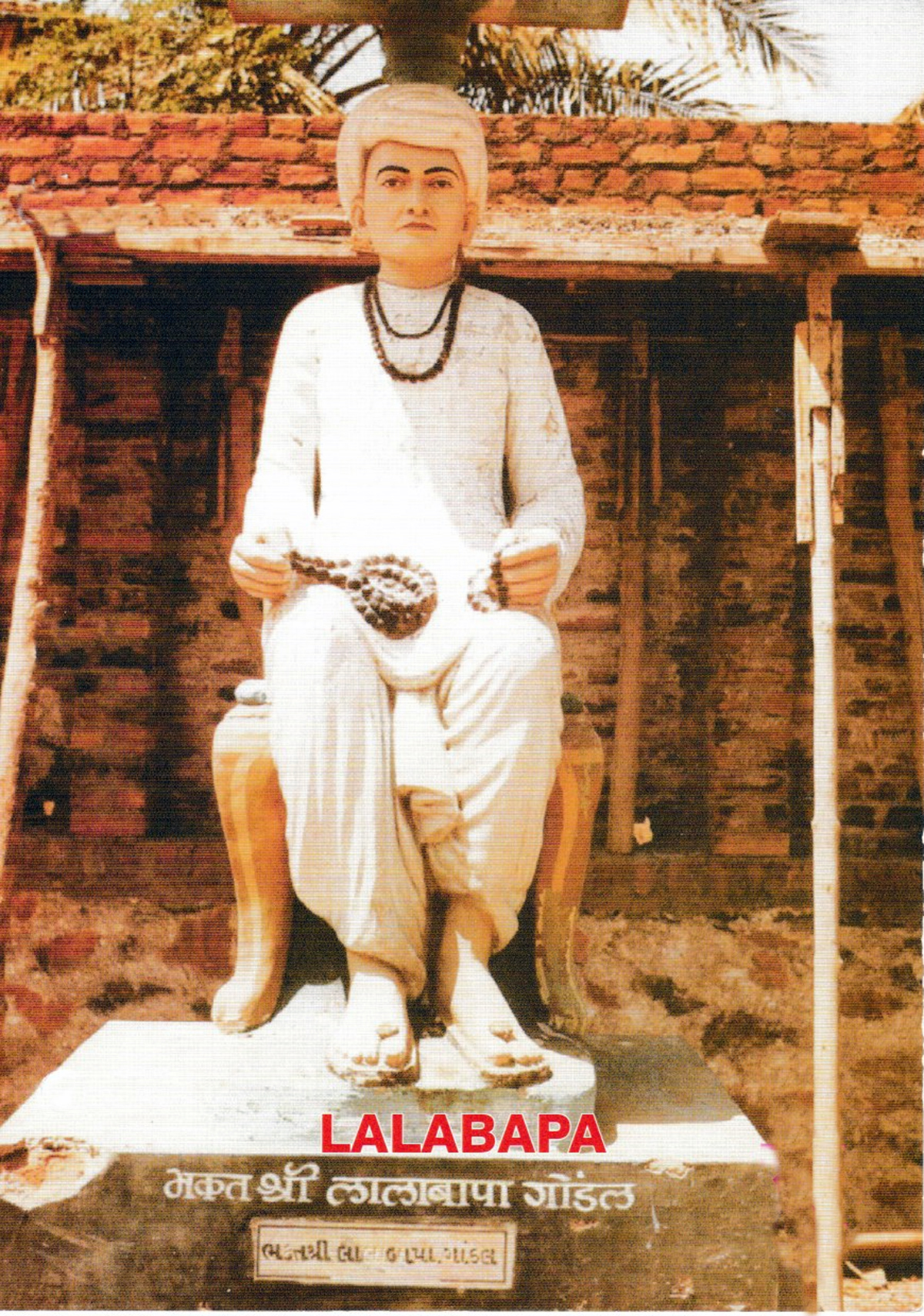
Pujya Lalababa was born in a small village called 'Reeb' near Gondal. He was of a religious nature since childhood. All children in his neighbourhood would gather around him. Pujya Lalabapa would collect some stones and worship them as God. After completing prayers, he would share the offerings (Prashad) with all his friends.
He used to sing bhajans (hymns) in a childish way. He started going to temple, listening to preachings from the priest. When Sadhus came to his village, he would talk about religion and offer his services to them. He was never interested in his curriculum studies. When he grew up, a Sadhulal took him to the mountains of Girnar, where he taught Pujya Lalabapa to meditate. He stayed in Girnar for a few years.
After gaining spiritual knowledge, the guru felt he was ready to return to Gondal. A statue of Ramdevpir was given to him and he was told to worship him. When drought set in, he lost his parents, brothers and sister. He then lived with his elder brother, who also died within 2 years. Pujya Lalabapa would daily wake up at 4am to pray, chant mala (beads) and do Aarti. After prayers he would go to his brother's shop, and delegate duties to staff and return home. He would then prepare food, and offer 'thali' to God. After that he would serve food to Sadhus and then eat. He would resume chanting and then the evening Aarti would be done. It became a daily routine of bhajan, kirtan and katha. Sadhus and neighbours joined in the ritual.
Five years passed by — as said by his Guru. A Sadhu called 'Jetakuba' was sent to Pujya Lalabapa with a basket containing God's statues. These statues were inaugurated in his house, which today IS a temple. Here people come for dharsham and satsang. Pujya Lalabapa always celebrated Ramnaumi, Janmashtami, Shivratin and his Guru's anniversary, in this temple. Time went by and Pujya Lalabapa's GuruS 25th anniversary was about to be celebrated and Invitations had already been sent out. Lalabapa then died, and the temple's 'sevaks' (helpers) were in a dilemma as what to do. The King of Gondal 'Bhagvatsingh' — a regular devotee of this temple, encouraged them to carry on with all the preparations. He gave his full support to put up a marquee, to supply water and provide food for all the villagers. The festival was celebrated for 3 days and nights with 'Akhand dhoon' (continuous chanting). The King announced to the crowd that the road should be named 'Lal Mandir Street'. On the day of Pujya Lalabapa's Samadhi (burial), people were given bund (sweet) and Ganthia (snacks) as prashad. Pujya Lalabapa's brother Guru Nyalchand mixed gold and silver flowers in wheat grains and scattered them in the air. The King Bhagwatsingh applauded loudly 'Bhakta Lalabapa ki jai' and the crowds repeated.
Since that era in all the towns and villages his anniversary is being celebrated every year with great faith. After Bapa's death, Nyalchandbhai continued the daily routine of the temple — prayers, bhajans and offering food to the sadhus. The villagers continued going to the temple for satsang and religious functions. A Jansari devotee named Surshyam would fondly sing bhajans. Another Jansari, Mojirambapu (music lover) would play the harmonium and accompany him. The temple was open to one and all. After a while Baljibhai was appointed as a caretaker of this temple.
In Pujya Lalabapa's time, he always experienced a shortage of cash. There were always expenses of feeding the Sadhus, festive costs and maintenance of the temple. Likewise 'Narshi Mehta', 'Thakurjl' had always fulfilled 'Bapas' demands in the form of miracles, whenever he was in a crisis. There are many incidents (Parchas) which Bapa experienced in his life. Once, Pujya Lalabapa had borrowed 25 rupees from a trader called Rajabapa Kotadya. After a few months the trader invited Bapa for bhajans at his house. He also reminded him to return his 25 rupees. The next day on his way to the trader's house, he met a man who gave him 10 rupees and said he was returning the money he owed him some time back. Pujya Lalabapa had 15 rupees and now had the full amount to pay his debt. He was so pleased and gave the money to the trader straight away. The trader asked "why are you paying me again, you already gave me 25 rupees yesterday!" Pujya Lalabapa immediately realized that 'Thakurji' (God) took his image to pay his debt.
Another time, Pujya Lalabapa borrowed 10 rupees from another Sadhu. One day he came to Pujya Lalabapa's shop, seeing him Bapa remembered his debt and straight away took 10 rupees from his till to pay the Sadhu. The Sadhu said "why are you giving me the money again? You yourself had paid me at my temple in the corner". Again Pujya Lalabapa knew and bowed to 'Thakurji', saying "you are not my servant, I am your servant'
Pujya Lalabapa had 'divine powers' and also gave 'Parchas' (miracles). Those who had faith in him experienced miracles and hope.
The Life of Sati Dudhimata
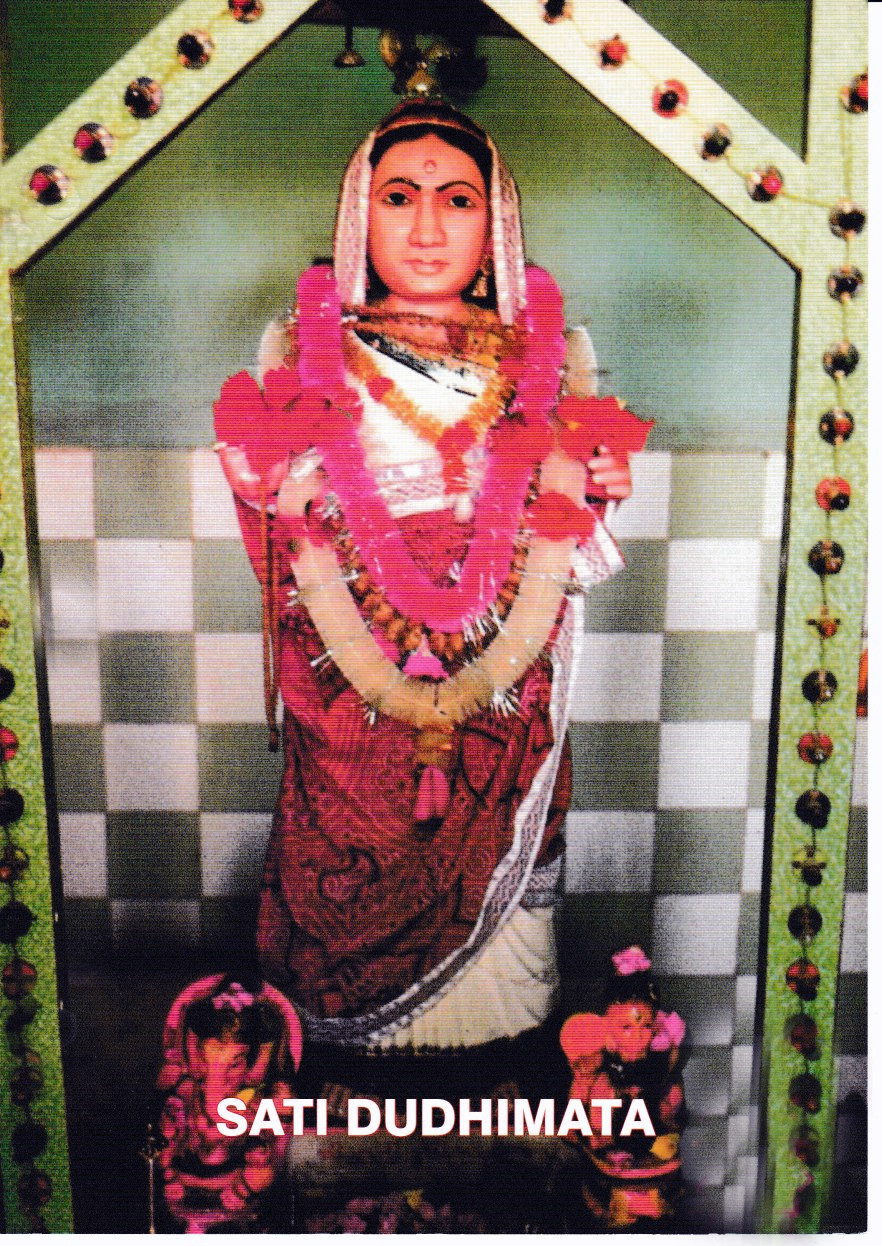
Sati Dudhimata was born in a small village called Segras. From childhood she was very kind and religious. When she was five to seven years old; her mother Jamnama would take her in the jungle to cut wood and gather cow-dung. There she met a Sadhu who gave her the 'mala (chanting beads). He taught her how to pray in the name of Ram Nam and disappeared. Since then Sati Dudhimata began chanting and had no Interest in playing games, work ng or socialising. She would sit cross legged in one room and meditate with her eyes shut. Day by day, she got engrossed in her prayers that her family members were worried. They didn't wish her to devote so much of her time in meditation. At times, her mother saw her praying at midnight, when she went to close the front door. Children of her age group would harass her by pulling her plait or removing the scarf from her head. Nevertheless, she never got annoyed with anyone.
Sati Dudhitmata's sister Manibhen was married to Kanji Gadavji Chavda of Barenj. Being married for ten years, she could not conceive a child, and her in-laws tormented her. Kanjibhai wanted to re-marry so that he could have a heir. Manlbhen thought; instead of getting some other woman, her sister would be ideal and would be able to look after her as well. Manibhen put this suggestion to her parents and they agreed without consulting Sati Dudhimata. Kanjibhai was hot tempered and couldn't tolerate her religious behavior. Sati Dudhitmata told him not to harass her and have faith in her. She told him that Manibhen will conceive a child within a year. With Mataji's blessings, Kanjibhai calmed down; thinking she was still immature. Within a week she returned to her parents; was upset and cried. She told them not to disturb her and went into a small room and begun her prayers. Seven days passed and no one had the courage to disturb her. They couldn't recognise her hidden divine powers
.Near Segras there was an annual fair (festival) of Bhajans and Kirtans. Sadhus and Sants were always in attendance. Sati Dudhimata asked her father Ramjibhai to take her also. He refused say ng that her inlaws were coming to fetch Ramjibhai was afraid that his daughter would not return. There were two well known saints — Sant Devidas and Sati Amarbai. There was another powerful devotee named Gangasati. Ramjibhai was scared that Sati Dudhimata might be influenced by her; and did not take her to the faiL
After a month, Ramjibhai returned from the festival. He was relaxing on his bed in the front courtyard. People of the village came to meet him and to hear all the news of the fair. In the meantime, Dudhimata was returning to her room after a bath. As she was walking towards her room, red powder (kamku) was spread on the floor from her feet. The room was lit up, filled with the scent of incense sticks, and drums were heard. Dudhimata was doing the Aarti with ten lamps (d vas) on her ten finger tips. All those who came to meet Ramjibhai witnessed the incident. They exclaimed to Ramjibhai that his daughter was a living Goddess. People began bowing down to her feet. Thereafter the family members began having faith in her. Rumours started spreading from town to town. People started bringing their sick children and when Sati DudhitmataS touched them they got betteL Ramjibhai's house became a shrine and people came from far and wide for darshan.
One day Sati Dudhimata's husband and father-in-law came to fetch her, but Ramjibhai explained that his daughter was not Interested in the worldly pleasures and has devoted her life to God. Sati Dudhimata's father-in-law (Yadavbhai) was annoyed that they went through all the wedding expenses and the outcome was negative. At that time Dudhimata was returning to her room after her bath to perform her prayers. Her husband followed heL He could not withstand her divine powers and murmuring nasty words to Sati Dudhimata left for Birenj. Walking towards the station, his vision became blurred. By the time he reached the station he was completely blind. Someone told him about Dudhimata, a Sati, in the town who could perform miracles. He was told to bow down to her feet to get his eyesight back. He was too angry to take their advice and boarded the train. He consulted a few doctors in his home town, but nobody could do anything. He then decided to visit Dudhimata to test her divine powers. When we bowed down to her feet, he began to see again. Sati Dudhimata told him to accept his first wife Maniben, who would conceive a son within nine months, and a daughter a year later.
Ramjibhai's financial position was not good, but people continuously came to his house. Sati Dudhimata used to cook a fist full of food in an urn (pot) and serve the food to all by herself. No matter how many people ate, the pot was never empty. There was always food, even after serving her own family members.
Once Ramjibhai had to do Ramdevpir's Paath and according to custom he invited a lot of people, more than he could afford. Some people came purposely to see how he would manage everything. Sati Dudhlrnata told Jamnama not to worry about anything. Sati Dudhimata cooked the food and served it to all the guests and the poor people who were waiting outside. After serving all, there was sti I food in the pot. Despite the room being small, everyone sat comfortably in the Paath. They al considered it lucky to have been in the presence of Sati Dudhimata. A time came when Dudhimata told her father her wish to take Samadhi (to be buried alive). In the month of Maha Sudh (4th) Sadhu Jivandas performed the ceremony. People came from all over chanting kirtans and scattering red powder (kanku). The ladies played Raas Garba and Dandiyas. Sati Dudhimata, clad in a white sari and holding a mala in one hand sat with her eyes closed in meditation. Finally, she was lowered in the hole that was dug for her. For the last time she opened her eyes and gave her mala to her father. Some people told Ramjibhai that he wouldn't be able to continue this ritual, so he quickly put the mala around Dudhimata's neck, which turned into a garland of fresh flowers! At this time, the group who had gone to the Mela were returning. They told Ramjibhai that they met Sati Dudhimata there and had given a message for him not to worry about her. The Sadhus had witnessed her presence at the Mela, whilst she was buried alive In Segras. The place where Sati Dudhimata took Samadhi has become a holy shrine for the people of Segras.
Shri Rama
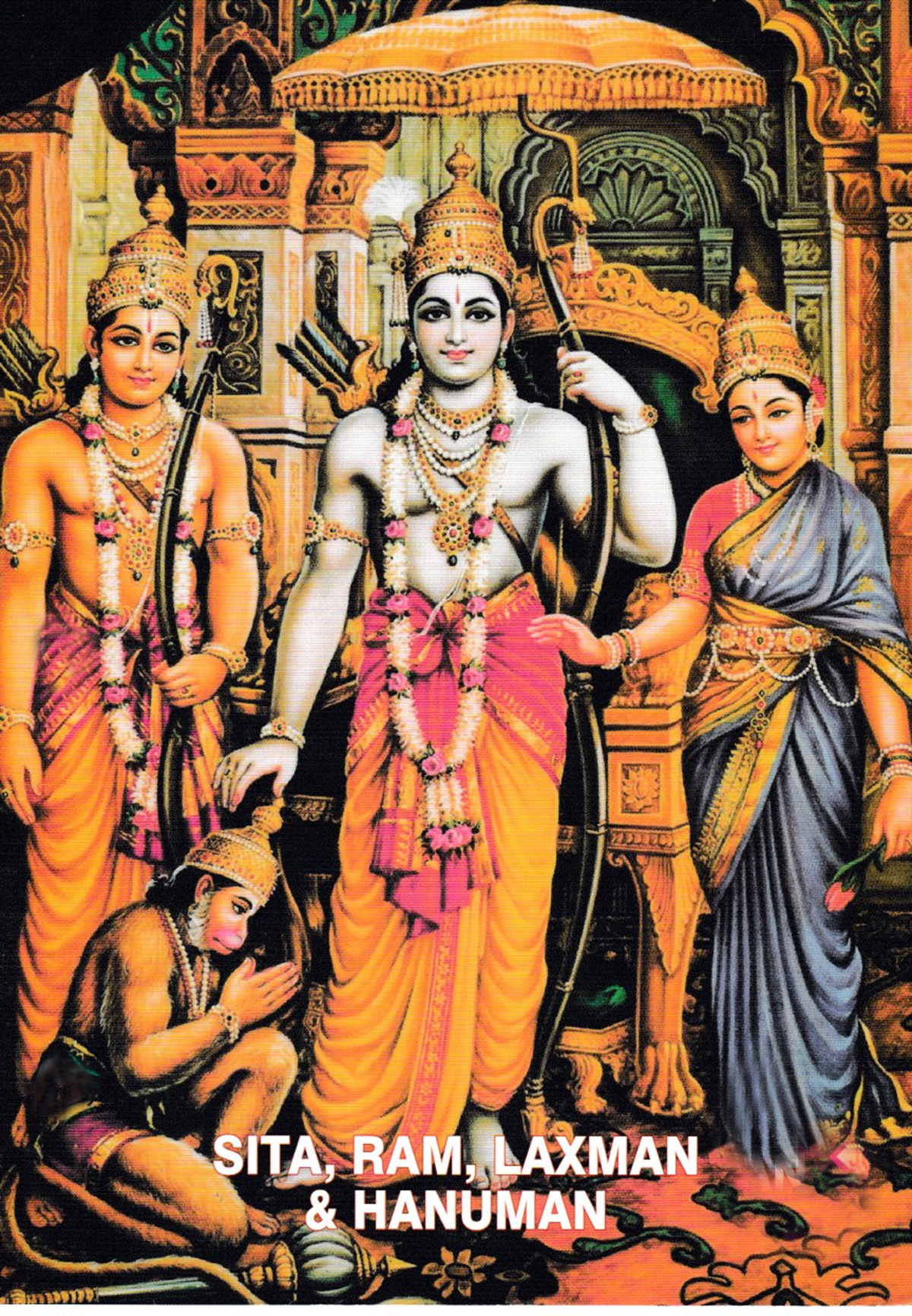
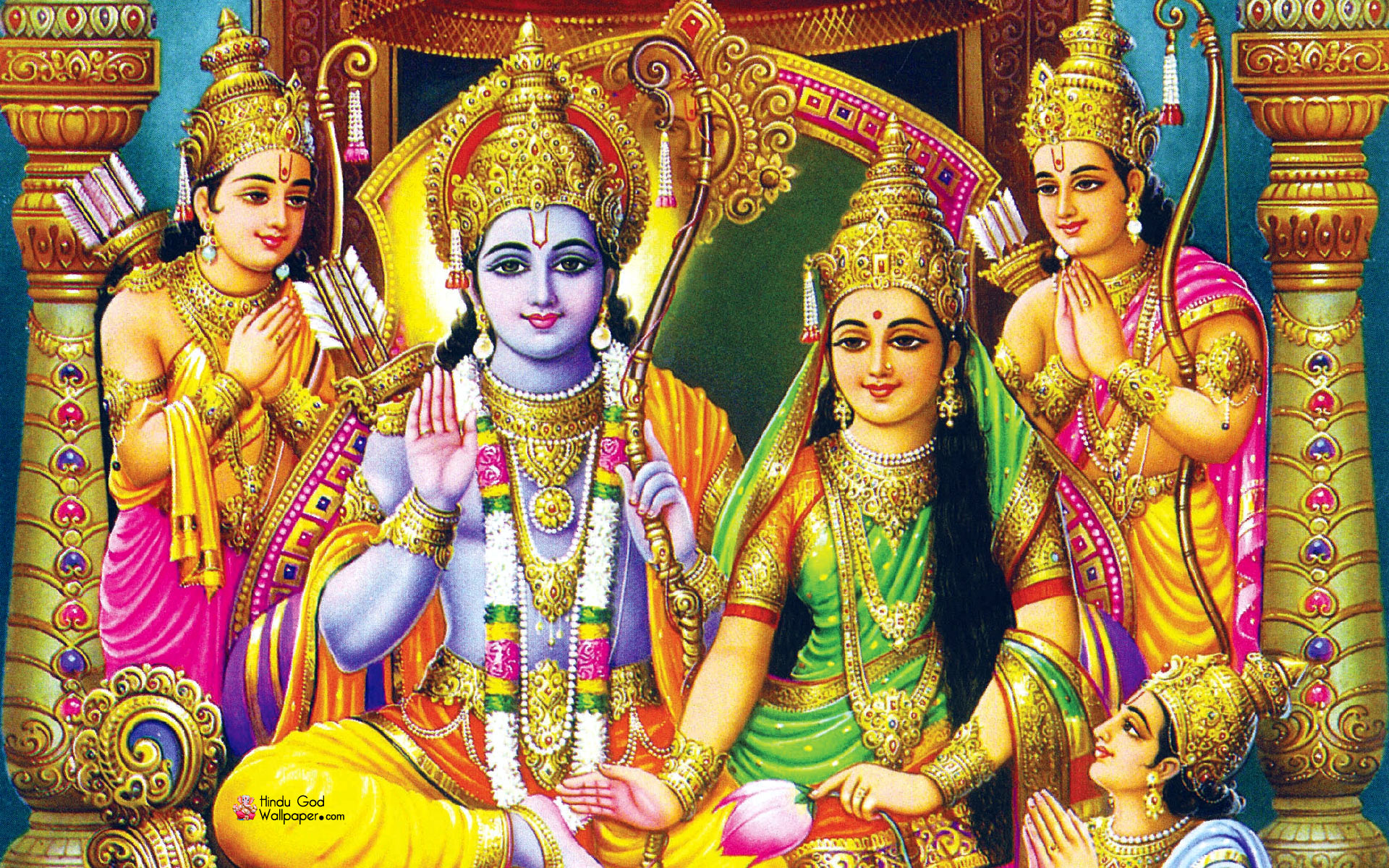
Rama or Ramachandra, the seventh incarnation of Vishnu, is normally shown as standing, having two arms, with one of which he holds a bow. He usually has his wife Sita by his left side, holding a blue lotus. His brother Lakshman, shorter than Rama, stands by his right side, holding a bow and arrow. Hanuman, the monkey god, is usually shown kneeling a little in front and by Rama's right.
Though a comparatively minor incarnation whose task it was to kill a tenheaded demon, Ravana, who held his wife captive, Ramachandra has deeply influenced the Indian psyche and has risen to be a deity whose life is a subject for literature and an example of moral excellence.
As the hero of the great epic of India, Ramayana, he has also passed into the mythology of countries other than India whose cultures have been influenced by it. Rama is also considered a saviour and friend and is sad to have the power of Intercession for the dead. When a dead body is carried for cremation, the pall-bearers loudly repeat the words 'Ram nam satya hai' (Rama's name is truth). Rama represents the qualities of fidelity, gentleness and steadfastness. In the same way his wife Sita (incarnation of Lakshmi, wife of Vishnu), is regarded as the embodiment of all that is most admired in Indian womanhood - faithfulness and affectionate compliance. They are looked upon as an example of constancy in marriage.
Celebrating the birth of Rama, this festival of Ramnavmi is held in MarchApril all over the world. At this time, temples dedicated to Rama are beautifully decorated with lights and flowers. Priests recite the Ramayana and highlight the important aspects of the life and character of Rama. The name of Rama is recited constantly as that is supposed to purify the heart.
Shri Shiva
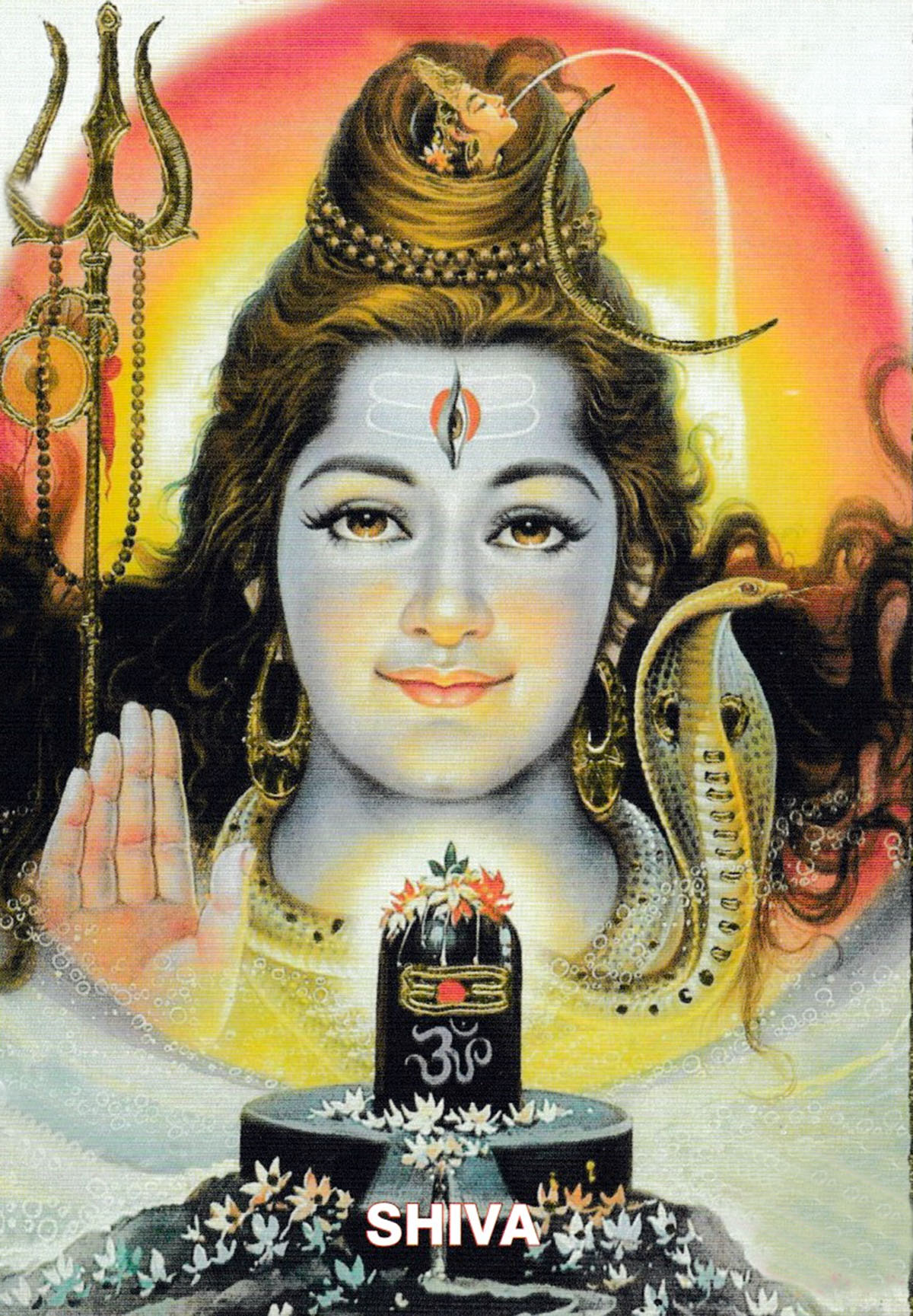
Shiva is one of the two most fundamental entities in the Universe: Shiva and Shakti. Hindu philosophy consists of mainly two schools of thought: the Advaitvaad (absolute monism) and the Dvaitvaad (dualism). The former asserts the existence of one Supreme Real ty that is at the root of all things that exist. The latter school argues that this Supreme Power manifests itself primarily •n two forms, male and female, and then into further manifestations, namely various deities and ultimately into everything that we see around us. Although there are often fierce arguments among the proponents of both these schools, modern science confirms that both of them are correct in their own context. Hence, according to the Dwaitwaad, Shiva is the male form of that Supreme Reality and is synonymous to Shakti (the female form) if one considers the Adwaitwaad.
Shiva means welfare, or a state of absolute bliss. He can perform the most difficult tasks without a hint of agitation. He is complete and is well beyond all the worldly sorrows. This is demonstrated in examples like the one when He smilingly drank all the dreaded poison that was produced after the churning of the ocean by the gods and the demons. This quality also makes Him the most generous and the most simplehearted of all deities, which is why He gives away boons very eas'ly to the devotee, sometimes even to the demons, who later go on to misuse those powers.
Shiva is the ultimate truth. Aesthetic wisdom has it that the truth is always beautiful. One of the great equations of Hinduism, "Satyam Shivam Sundaram" is based on this principle. It then follows that anything that IS beautiful can be seen as a manifestation of Shiva Himself. It is this conviction that leads Hindus to see the God in every good thing. Often Shiva is also known as Mahakaal. The word 'kaal' itself is an interesting term: it means both 'time' and 'death'. Hence Shiva can be referred to as the death of all deaths and also as the time of all times. It is this reason why Shiva is immortal.
Another interpretation of the word Mahakaal is that He is the ultimate destroyer. All things that are born must die one day and the task of Shiva is to ensure the end of anything that has completed its lifetime.But life and death complement each other like two sides of the same coin. Hence Shiva is also the supreme creator — even the creator of all the other deities. There is a story that once the sage Naarad asked Lord Shiva who the atter's father was. Lord Shiva smiled and tried to disregard the question at first. But when Naarad, known for his keenness for knowledge, insisted too much, Lord Shiva said His father was Lord Brahma. Far from satisfying Naarad, this only made him more curious and he asked who Brahma's father was. To further dispel the topic, Lord Shiva said, "Lord Vishnu." But there was no end to Naarad's curiosity. He asked, "who is Lord Vishu's father then?" With a gentle smile, Lord Shiva replied, "Vishnu's father is myself!" The essence of the story is that Shiva is both, the beginning and the end. In fact, He is infinite and has no parents since He was never born. Something that never took birth can never die. He is omnipresent and resides in everyone as pure consciousness. The Shiv Ling is a symbol of the generative power among all beings.
Lord Shiva is mentioned in almost all spiritual scripts of Hinduism. Apart from the Vedas, the Shiva Maha Puraan describes the attributes of Lord Shiva in detail. The works of sages Vyas, Vasishtha, Patanjali, the poet Kalidas and the spiritual leader Adi Sankaracharya look at the character of Shiva from various angles. The main festival of Shiva is Maha-Shivratri, celebrated in the lunar month of Maha.
Hindu Festivals and current calendar
Hindu culture and meaning of religious symbols
Articles about our gods and godesses

Articles submitted by community members

Hindu calendar 2019